Why Valley Summers Bring the Signs On Sooner
Heat is what wears a transmission out, and this valley has plenty of it. Temecula sits at 1,020 feet, and July and August highs average 96.7°F and 97.6°F, per the same climate table. The August record is 118°F.
Fluid takes that heat first. Wikipedia's entry on automatic transmission fluid says oxygen reacts with hot fluid and can cause oxidation, rust and corrosion. It lists driving mainly in heavy city traffic in hot weather, and frequent towing, as severe conditions. Under those, one schedule it cites calls for new fluid and a filter every 45,000 miles.
That describes a lot of local driving. Temecula Parkway is a six lane city road full of lights, and the state is adding lanes on Interstate 15 to cut the weaving near the I-215 split. A summer of that, or a boat towed to the lake, ages fluid faster than the normal column in your manual assumes.
Old fluid is not a failure by itself. It is the reason the first signs below tend to show up here a little sooner, and the reason a test should come before a rebuild quote.
The Early Signs, Earliest to Worst
The Federal Trade Commission's auto repair basics list four transmission warnings. Abrupt shifts, delayed engagement, failure to shift, and slipping, where the engine revs and the car does not respond. The table adds the rest and puts them in the order drivers tend to notice them.
| Sign | How It Shows Up | What It Often Turns Out to Be | Next Step |
|---|---|---|---|
| 1. Pause going into drive or reverse | A beat before the car takes gear, worst on a cold morning | Low or worn fluid, or a pump or seal losing pressure | Book a test this week |
| 2. Harsh, late or abrupt shifts | A bang into second, or a gear held too long | Worn or wrong fluid, a shift solenoid, or adaptive learning lost after a battery change | Have the codes read |
| 3. Shudder at steady speed | Like rolling over rumble strips on a light throttle | Torque converter lockup or an engine misfire | Road test before any parts |
| 4. New whine or hum | A sound that rises with speed and was not there last month | Low fluid, a worn pump, or a bearing | Check the level the way the manual says |
| 5. Red oily spots | Drips under the middle of the car where you park | A transmission or power steering leak | Cardboard under the car overnight |
| 6. Slipping | Revs climb and the car does not speed up | Clutches not holding, often from low or burnt fluid | Drive as little as you can |
| 7. Warning light or limp mode | A light, and the car stuck in one gear with little power | The computer protecting the transmission from a fault it saw | Read the code before a long drive |
| 8. No drive, no reverse, or a heavy knock | The engine runs and the car will not move right | A failure inside, or a loose torque converter | Tow it, don't drive it |
The early signs share one cause. Fluid pressure is what clamps each clutch, and a transmission that is losing pressure shows it first when a clutch has to apply from rest. That is the shift into drive or reverse. Once pressure drops further, the clutches start to slip under load, and that is when the heat and the damage climb.
So a pause going into gear is not a reason to panic. It is a reason to test while the fix might still be fluid, a seal or a solenoid. Signs six to eight are the ones where waiting costs money.
Check the First Ones in Your Driveway
You can test the early signs without tools. Do it with the car cold, after it has sat overnight.
Start the engine and hold the brake. Shift into drive and count how long it takes to feel the car take gear. Then try reverse. A clean shift engages almost at once. A pause you can count is worth writing down.
Drive your normal route and pay attention to the shifts, not the radio. Note whether a bang or a late shift happens cold, hot, or both. Watch the tach on a freeway on ramp. If the needle jumps and the speed doesn't follow, that is slip.
Park over a piece of cardboard for the night. Red oily drops near the middle of the car point to a leak, per the FTC. Bring the cardboard and your notes to the visit. They shorten the diagnosis.
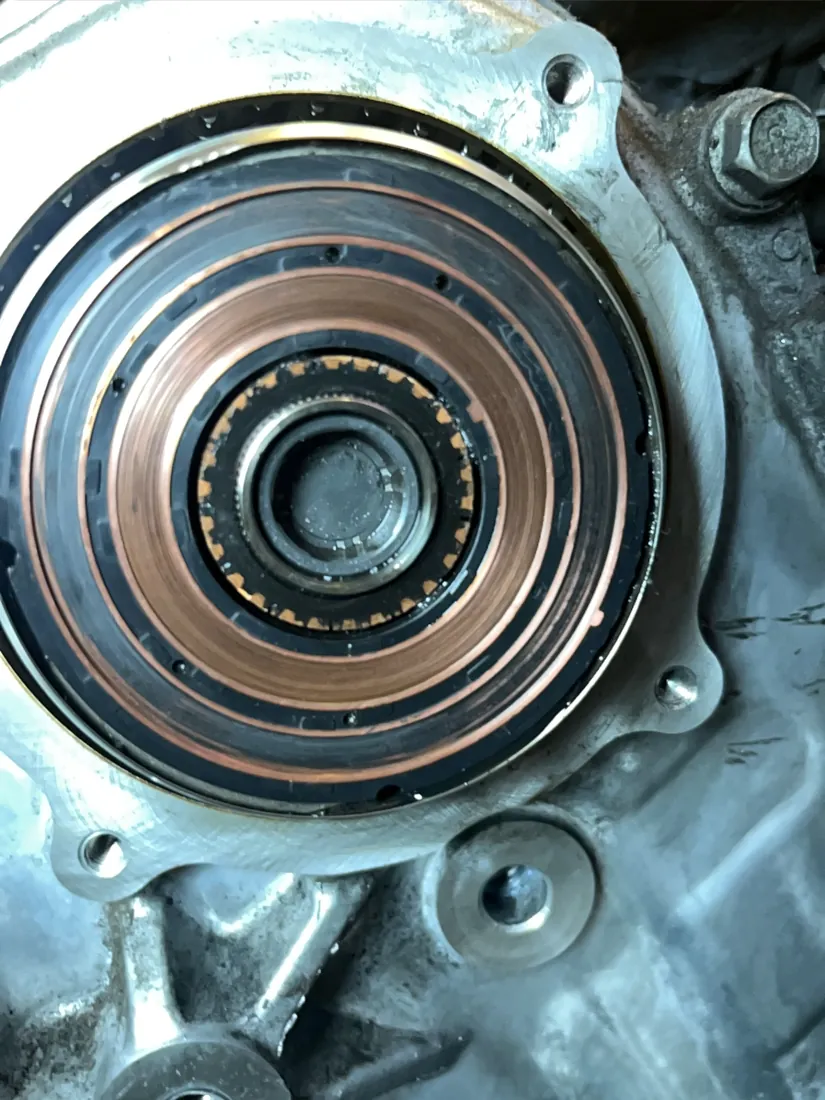
Check the fluid only if your car has a dipstick, and only the way the manual says. Many newer cars have none and use a fill plug instead, per Wikipedia. A guess on those leads to overfilling. The six signs of bad transmission fluid guide covers what the fluid itself can tell you.
Signs That Aren't the Transmission
A lot of cars get called a transmission job when the fault is somewhere else. Four look alikes come up again and again.
An engine misfire under load feels much like a converter shudder. Temecula Mobile Mechanic's transmission page says a shake under load at a steady speed is often one or the other, and a road test tells them apart. A misfire usually sets its own code too.
A clunk when you shift into gear can be a worn engine or transmission mount letting the whole unit rock. A click on tight turns is usually a CV axle, not the gearbox. A hum that changes with speed but not with gear can be a wheel bearing.
The converter has failure modes of its own. Wikipedia's torque converter entry lists overheating from constant slippage, stator clutch failure and blade damage. A broken stator clutch can leave a car barely able to move under its own power. The FTC links a heavy knock to a loose torque converter as well as to worn engine bearings.
Each of these sends a driver toward a transmission quote. Each is cheaper to find with a test than with a teardown.
What the Fix Usually Is, and What It Costs
Temecula Mobile Mechanic tests in a set order. Fluid level and condition come first, since burnt fluid tells a lot by smell. Then a scan of the transmission and engine modules, a look at the gear the computer asked for against the gear it got, and line pressure where the car reports it. Low fluid, a failed shift solenoid, a wiring fault or lost adaptive learning are hours of work, not days.
These are the shop's listed ranges, parts and labor, on its price list. A diagnosis runs $95 to $150, and the fee comes off the repair if the shop does the work. A fluid and filter service runs $180 to $360, done as a drain and fill with the correct spec fluid. A rebuild or swap is quoted after the diagnosis, with remanufactured options priced beside it.
The test happens where the car sits, with no call out fee in the valley. A rebuild or swap is done at the shop's garage, and the car is towed there. Every repair carries a 3 year warranty on parts and labor.
One thing a fluid change cannot do is fix a transmission that is already slipping from worn clutches. If the test says the trouble is inside, money spent on fluid is wasted, and a good shop will say so before you pay for it.
Your Rights Before Anyone Opens It Up
California gives you real protection on a big job like this. A shop must give you an estimate of the cost and get your approval before it starts, per the Bureau of Automotive Repair. Extra work needs your OK too. The FTC says to get that estimate in writing and keep a signed copy. You can ask for your old parts back, as long as you ask before you approve.
The FTC adds two habits worth keeping. Ask whether there is a charge for the diagnosis if you take the repair elsewhere. And get a second opinion on an expensive or complicated repair, since a shop that only diagnoses has less reason to sell you parts.
Ask any shop four questions before you approve a transmission job. What did the test show, in numbers or codes? Is there a teardown fee? Is the price for a rebuild of your unit or a replacement? What does the warranty cover, and for how long?
Book a Transmission Test
If your car shows any of the first four signs, start with a test, not a part. Book a visit or call (951) 618-1982. Temecula Mobile Mechanic covers Temecula, Murrieta, Menifee, Wildomar and the rest of the valley.